The Decisions Behind America’s Open-Access Future Are Being Made Right Now

June 19, 2026 2 min read Scott Baker, Sajan Parikh, Carroll Gray-Preston

If your organization is interested in what broader open-access adoption and stronger interoperability across the ecosystem can unlock for the industry, it should be at the table.

Across North America, ATIS’ groundwork is enabling a shift in how internet infrastructure gets built and shared. Open-access networks, where a single network owner leases infrastructure to multiple competing internet service providers (ISPs), have the potential to dramatically accelerate broadband deployment and increase consumer choice. But realizing that potential requires more than capital, fiber optic cable, copper cables, radio waves (wireless), and satellites. It requires the industry to agree on how to actually do it.

ATIS is central to accelerating this progress. Through its Open Access Network Forum (OANF), ATIS is convening ISPs, open-access infrastructure providers (OAPs), and their technology partners to develop the standards, architectures, and commercial frameworks needed to make open-access networks deployable at scale. The goal is practical and concrete: reduce integration friction, align technical and operational practices, and produce guidance that accelerates adoption across the North American market.
OANF will help bring greater consistency to how open-access networks are designed, integrated, and operated, making it easier for service providers to launch and expand services for end users across the North American market. This initiative is another way ATIS is advancing ICT industry transformation by helping simplify service enablement in open-access environments.

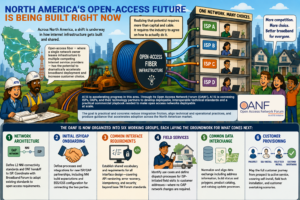
The Forum is now organized into six working groups, each laying the groundwork for what comes next:

Network Architecture

Define L2 NNI connectivity standards and ONT handoff to ISP. Coordinate with Broadband Forum to adapt existing standards to open access requirements.

Initial ISP/OAP Onboarding

Define processes and integrations for new ISP/OAP partnerships, including NNI build expectations and BSS/OSS configuration for connecting the two parties.

Common Interface Requirements

Establish shared vocabulary and requirements for all interface design — covering API versioning, error recovery, idempotency, and security beyond base TM Forum standards.

Field Services

Identify use cases and define dispatch processes for ISP-initiated field visits to customer addresses — where no OAP network changes are required.

Common Data Interchange

Normalize and align data exchange including address information, build status and polygons, product catalog, and catalog update processes.

Customer Provisioning

Map the full customer journey from prospect to active service, covering self-install, field tech installation, and customer overtaking scenarios.

If your organization is interested in shaping the critical groundwork for open-access network deployment, contact ATIS Vice President – Innovation Carroll Gray-Preston at cgray-preston@atis.org.


 

About the Authors

Scott Baker

Expert Solution Architect at AT&T Corporate ServiceNow Platform Architecture, AT&T Technology Services

Scott Baker has been with AT&T since 2008 and spent his time initially managing network monitoring and development teams before pivoting into architecture full-time. He spent several years as a solution architect, building complex solutions to improve AT&T’s end to end tech stack supporting its enterprise products. In 2018, Baker moved over to ServiceNow Architecture as the lead ServiceNow architect for AT&T. In conjunction with AT&T’s ServiceNow roadmap, its involvement in TMForum standards grew. When AT&T began the project that would become Gigapower, Baker got involved in Open Access for the first time where his role was both to oversee how ServiceNow was used within the architecture and, given his TMForum experience, assist in the development of how AT&T would employee TMForum standard interfaces in Open Access. He’s since been an active participant in TMForum, including the Wholesale Broadband Project, and advocating for enhancing and broadening the standards. Baker continues to work with the AT&T Open Access team to evolve the standards as they’ve expanded to multiple OAP partnerships.

Sajan Parikh

Chief Technology Officer at COS Systems

Sajan has spent 17 years in the telecom industry, working across fiber and fixed wireless networks, large-scale systems architecture, and the operational realities of running and scaling service providers. He has worked directly with network operators, retail service providers, municipalities, utilities, and infrastructure-backed fiber platforms. Over the course of his career, he has led greenfield builds, brownfield transformations, and both pre- and post-acquisition technical consolidations. His experience includes converting traditional retail ISPs into wholesale and open access models and designing the systems required to support them. Sajan has deep hands-on experience implementing TM Forum APIs in production environments, with a focus on interoperability, automation, and operational scalability. His work spans wholesale ordering frameworks, provisioning orchestration, service location data architecture, and multi-tenant OSS/BSS design. He is known for translating real-world operational constraints into practical system architecture that works at scale. As Vice Chair of the ATIS Open Access Network initiative, Sajan brings a practitioner perspective to standards development. He is focused on addressing the lack of consistency that forces open access deployments into bespoke, high-cost integrations. His goal is to help establish clear, pragmatic standards that reduce friction and enable repeatable, scalable shared infrastructure models across North America.

Carroll Gray-Preston

Vice President – Innovation at ATIS

Drawing on extensive experience as an R&D leader, systems architect, and strategic planner, Carroll Gray-Preston leads the ATIS Technology and Operations (TOPS) Council, guiding collaborative industry initiatives focused on 5G Standalone deployment, network APIs, artificial intelligence, Zero Trust security, and the evolution toward 6G. She works with service providers and technology leaders to develop actionable industry guidance, including recent initiatives on RAN optimization for Fixed Wireless Access, AI-enabled network automation, and next-generation network security, helping ATIS members translate emerging technologies into practical business and operational value.