Introduction
Since its launch in October 2023, the ATIS AI Network Applications (ANA) Group has been advancing one of the telecom industry’s most consequential questions: how can generative AI move beyond automation to deliver truly intelligent, adaptive networks? Among the group’s two priority initiatives, the Wireless Physical-Layer Foundation Model and the Cognitive Assistant for Network Operators, the latter is now taking shape as a concrete system: the ANA Neuro-Symbolic Cognitive Assistant, or NESY.
NESY is designed for exactly the environment that next-generation networks are creating. NeSy is engineered specifically for the complexities of next-generation 6G architectures, where networks must navigate high-dimensional data streams and non-linear interference. Conventional Large Language Models (LLMs) function primarily as “black boxes,” excelling at statistical pattern recognition but lacking the formal logic and causal grounding required to explain their outputs. This lack of transparency poses significant challenges for systems subject to rigorous legal frameworks, such as the EU AI Act, which mandates traceability and explainability.
This blog is the first in a new ATIS series about NESY, the ANA Neuro-Symbolic Cognitive Assistant [1]. It will help explain how NESY, which consists of multiple self-aware agents, moves beyond raw data processing toward true semantic understanding.
Enter the Society of ANA
To solve this, we’ve architected the ANA Neuro-Symbolic Cognitive Assistant using a Reactive-Deliberative-Reflective framework, inspired by the cognitive theories of Aaron Sloman [2] and Marvin Minsky [3]. This “Society of ANA” approach mirrors Minsky’s Society of Mind by splitting the assistant into three specialized cybernetic robots that work together to turn noise into knowledge.
The Cybernetic Robot Roster that makes up NESY is:
1) PULSE (The Kinetic Scout): A small, high-speed, multi-limbed robot designed to “skate” along signal lines. Pulse identifies patterns in raw radio frequency (RF) data at the speed of light.
2) LATTICE (The Logic Sentinel): A tall humanoid robot with geometric data-plates. He carries a digital “Knowledge Tablet” containing the network’s rulebooks, SLAs, and regulatory ontologies.
3) MIRROR (The Orbital Core): A spherical, floating sentinel that hovers above the team. His large, concave mirror-visor glows green when he validates the system’s “Way to Think” via the meta-cognition loop.
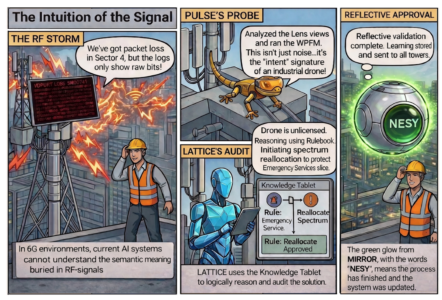
Frame #1: The Problem – The Blindness of Traditional AI
The setting: The RF Storm. A dense city using 6G. Jagged “noise bolts” are hitting a gNodeB tower. A Network Engineer looks at a tablet showing chaotic logs.
As our Network Engineer discovers in the first panel of our first cartoon, 6G logs can be overwhelming. When packet loss occurs, traditional systems see “raw bits.” This can be thought of as a sea of chaotic noise that offers no clear path to a solution. These “connectionist” models excel at pattern recognition but often lack the semantic understanding needed to handle the high-dimensional noise of 6G.
The cartoon is shown below.
Frame #2: Pulse’s Probe – The Intuitive Sense (Reactive Layer)
The setting: Pulse (the geckobot) skitters onto an antenna. His amber visors flash as they scan the “noise bolts,” highlighting a hidden drone icon within chaotic signals.
When the “RF Storm” hits, Pulse (The Kinetic Scout) is the first responder. Pulse doesn’t “think” in the traditional sense; he identifies patterns at the speed of light using the Wireless Physical Layer Foundation Model (WPFM).
Pulse uses the WPFM to analyze IQ-based time series representation of the RF environment, Pulse can look through his “Neural Lens” and see the hidden “meaning” of a signal rather than just its power level. In our story, Pulse realizes the interference isn’t just noise, but instead is the specific signature of an industrial drone.
Frame #3: Lattice – The Logical Architect (Deliberative Layer)
The setting: Lattice stands at the base of the tower, checking his digital tablet. His plates shift and lock as he verifies a rule.
Once Pulse identifies the “what,” Lattice (The Logic Sentinel) determines the “so what.” Lattice is the Symbolic Engine of the system. He carries a digital “Knowledge Tablet” filled with ontologies, regulatory rules, and Service Level Agreements (SLAs). Lattice applies Symbolic Logic to Pulse’s perceptions, ensuring that all actions comply with regulatory “hard constraints” and SLAs.
Lattice reasons through the rulebook to find a solution that is not only effective but compliant. He confirms the drone is unlicensed and triggers a spectrum re-allocation to ensure that critical “Emergency Services” traffic remains untouched. This provides explainable AI in the form of decision traces[1] and audit trails, as required by regulations such as the EU AI Act.
Frame #4: Mirror – The Orbital Core (Reflective Layer)
Setting: Mirror floats above, symbolizing the meta-cognition and reflective powers of NESY. Mirror is the most critical part of this cognitive loop. Floating above the team, Mirror monitors the interactions between sensing and logic. When he sees that the team has successfully bridged the gap from raw bits to semantic intent, his visor glows a vibrant green.
This isn’t just a status light; it represents Reflective Validation. Mirror performs meta-cognition[2], validating the success of the Sensing and Logic and updating the internal policy to enhance future autonomy. This success is then stored and distributed so that every tower in the fabric “learns” how to handle similar drone interference in the future.
Why This Matters for 6G
The transition from 5G to 6G is more than just a speed boost; it is a shift toward Intelligence Fabrics. By giving the network a “Society of Mind,” we create a system that:
- Learns continuously from its own operational experiences.
- Bridges the skills gap by providing natural language explanations to engineers.
- Heals its own logic, ensuring it remains resilient even in unforeseen conditions.
The green glow is just the beginning. Stay tuned for our next chapter, where we explore how the team handles a “Stalemate of Logic” in The Wisdom of the Rulebook.
References
[1] J. Strassner, editor, “NESY: A Neuro-Symbolic Cognitive Assistant for Next Generation Networks,” April 2026, ATIS whitepaper ANA-2026-00018R000
[2] A. Sloman, and B. S. Logan, “Evolvable architectures for human-like minds.” In G. Hatano, N. Okada, & H. Tanabe (Eds.), Affective Minds (pp. 169–181). Elsevier, 2000.
[3] M. Minsky, “The Society of Mind,” Simon & Schuster, March 1988, ISBN 978-0671657130t.
Footnotes
[1] A “decision trace” is a record of all of the reasoning and decisions that led to the final response given by ANA’s Neuro-Symbolic Cognitive Assistant. For each decision leading to the final response, all axioms, theories, facts, and inferences are recorded, along with their timestamps.
[2] Meta-cognition is literally “thinking about what was just thought about.” It is the capacity of an entity to monitor, evaluate, and regulate its own cognitive processes — knowing what it knows, assessing confidence, and adjusting strategies based on that self‑assessment.