The Crisis Unfolds
The tone hit the operations center at 3:11 a.m.: the distinctive three-burst alert reserved exclusively for mass-casualty events. A multi-vehicle pile-up on Interstate 15 near the Nevada-California border had triggered simultaneous activations: two trauma centers, four ambulance units, a helicopter medevac, and a coordinated fire-rescue team. Every one of them depended on the same 5G/6G network fabric for real-time coordination, body-worn camera feeds, and digital patient triage data.
Network Operations Engineer Marcus Webb stared at his holographic console as four simultaneous Priority-1 slices lit up red:
- SLICE-EMS-ALPHA: Paramedic telemetry and voice command — LATENCY BREACH: 47ms / Threshold: 10ms
- SLICE-FIRE-BRAVO: Incident Command video coordination — BANDWIDTH DEGRADED: 1.2 Mbps / Required: 8 Mbps
- SLICE-MEDEVAC-CHARLIE: Air-to-ground (ATG) navigation sync — PACKET LOSS: 12% / Threshold: 0.1%
- SLICE-DISPATCH-DELTA: Multi-agency dispatch backbone — HOLDING — RESOURCES EXHAUSTED
This was not a single service-level agreement (SLA) violation. This was four-way resource contention across a shared network infrastructure during a declared public safety emergency — precisely the scenario that separates rule-following automation from genuine cognitive intelligence. For Marcus, this meant that ATIS’ Neuro-Symbolic Cognitive Assistant for 6G Networks’ (NESY’s) “Society of Mind,” would face its true test. NESY emerged from the work of ATIS’ AI Network Applications (ANA) Working Group.
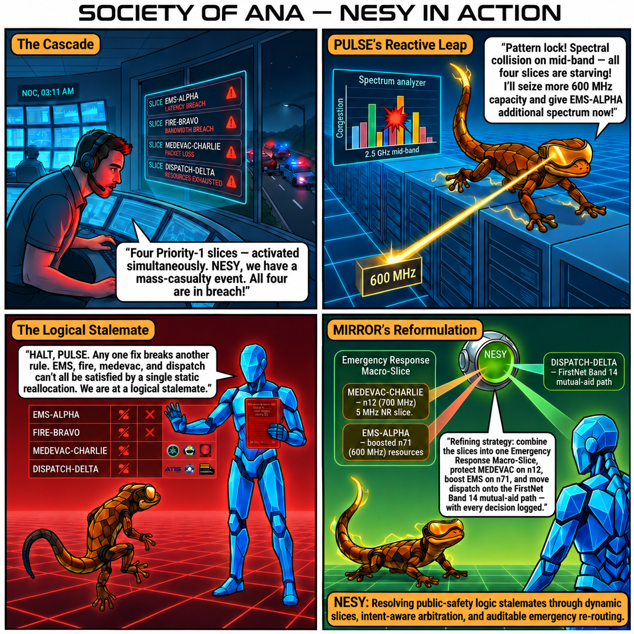
NESY resolves a four‑way emergency-services stalemate by dynamically recomposing slices into a single Emergency Response Macro‑Slice, then applying intent‑aware arbitration and temporally re‑routing traffic across n71, n12, and FirstNet Band 14 with a full audit trail for every decision.
This scenario runs on T-Mobile’s network. The operator holds n71 (600 MHz, ~35+35 MHz total) for its primary 5G coverage layer and Band 12 (700 MHz, 5+5 MHz) as its LTE low-band anchor. AT&T’s FirstNet Band 14 (700 MHz, 10+10 MHz) is a separate, dedicated public-safety network accessible under a pre-negotiated mutual-aid agreement for declared emergencies — it is not T-Mobile’s to reassign unilaterally. NESY’s task is to optimize within the available T-Mobile spectrum while correctly respecting the boundary between T-Mobile-controlled resources and the AT&T/FirstNet Band 14 lane.
PULSE’s Reactive Leap
Before Marcus could finish reading the alert cascade, PULSE had already sprung into motion. The small, multi-limbed amber gecko-bot skittered furiously across the virtual network topology map, his sensor clusters sampling packet flows across all four slices simultaneously.
“Pattern lock!” PULSE’s systems flashed, limbs flickering with analytical energy. “I’m seeing spectral congestion on the 2.5 GHz mid-band shared between all four slices. Solution: seize the 600 MHz anchor band and reallocate 20 MHz of additional spectrum to EMS-ALPHA. Executing now…”
It was quintessential PULSE: fast, decisive, data-driven. His neural sub-system had correctly identified the root cause: mid-band spectrum starvation caused by simultaneous activation of four high-priority slices and mapped a plausible remedy in milliseconds. In simpler incidents, that speed had saved lives.
But Marcus recognized the look on PULSE’s amber visors. He had seen it before. Speed without constraint is just another form of chaos.
The Symbolic Stalemate
“HALT.”
LATTICE’s geometric data-plates locked into a rigid formation, one crystalline arm extended palm-forward. His Knowledge Tablet blazed a deep crimson, projecting a multi-layered conflict map that hung in the air between them.
“PULSE, your reallocation solves EMS-ALPHA. It does not solve the others.” LATTICE’s voice was precise, unhurried, and final. “Applying the North American Public Safety Communications SLA Ontology, cross-referenced with applicable FCC spectrum regulations, including FCC Part 90 Public Safety Pool rules, the FirstNet Band 14 license terms, and the ATIS Emergency Priority Framework, the following hard constraints apply simultaneously. I have evaluated all available spectrum pathways, including n71, n12, the congested 2.5 GHz mid-band, Band 14, and the 4.9 GHz public safety broadband channel. Each carries a binding constraint that PULSE’s reallocation did not account for.”
The tablet displayed the cruel arithmetic of the situation:
| Constraint | Rule or SLA Reference | Conflict |
| EMS-ALPHA latency < 10ms | ATIS PS-SLA-001 (Public Safety SLA Ontology) | Requires additional low‑band spectrum and/or dynamic reallocation during mass‑casualty events |
| MEDEVAC-CHARLIE packet loss < 0.1% | FAA AC‑90‑117 (Data Link Communications) – aeronautical air‑to‑ground data‑link safety and integrity requirements, combined with the site‑specific SLA for MEDEVAC‑CHARLIE (packet loss < 0.1%) | Requires a highly reliable, low‑loss ATG channel; not every band or deployment configuration is suitable for critical ATG telemetry during turbulent or obstructed conditions |
| FIRE-BRAVO bandwidth ≥ 8 Mbps |
NFPA 1221-2022 (Emergency Services Communications Systems) | Competes for the same congested mid-band spectrum as EMS‑ALPHA and MEDEVAC‑CHARLIE |
| DISPATCH-DELTA always-on priority | FirstNet Spectrum Act / FCC Band 14 License Terms
|
Band 14 is AT&T/FirstNet-controlled — T-Mobile may only invoke it under mutual‑aid, not reassign it as an internal anchor band |
| Protection of public safety channels | FCC Part 90 Public Safety Pool (47 CFR Part 90 Subpart B) | Public safety channels (including legacy LMR and designated broadband) cannot be repurposed as generic carrier capacity without specific authorization |
“Any action that satisfies EMS-ALPHA by pulling low‑band capacity away from the protected ATG path risks degrading the highly reliable, low‑loss channel reserved for MEDEVAC‑CHARLIE,” LATTICE continued. “Any attempt to treat Band 14 as just another T‑Mobile anchor resource would violate the FirstNet licensing terms and the mutual‑aid boundary conditions for DISPATCH-DELTA. We are at a logical stalemate. No single rule-compliant action resolves all four constraints simultaneously.”
Marcus felt the weight of the silence that followed. He had worked with AI systems that would have simply picked the highest-priority slice and let the others degrade. LATTICE would never do that. However, the very rigor that made him trustworthy had locked him in place. Pure symbolic reasoning, for all its explainability and compliance power, had frozen at the intersection of four legitimate but mutually incompatible obligations.
This was the stalemate NESY was designed to break.
MIRROR’s Reflective Resolution
Above the virtual operations floor, MIRROR had been silent, but not idle. The spherical floating sentinel’s concave visor had shifted from its resting amber to a deep, pulsing cobalt as his meta-cognitive processes engaged. MIRROR was not re-checking whether PULSE and LATTICE had executed their functions correctly. He was doing something more fundamental: examining the reasoning structure itself.
Why had four slices collided? Not bad luck; it was a failure of anticipation. The system had provisioned four independent Priority-1 slices assuming they would never activate simultaneously. Were the constraints truly incompatible? Only if each slice was treated as an isolated pipe competing for the same static resource pool. What did the constraints actually intend? Not to preserve spectrum allocations… but to preserve human lives.
MIRROR’s visor blazed a decisive, luminous green.
“Refining strategy,” MIRROR announced, his projected light illuminating the conflict map and redrawing it entirely.
“PULSE: Your detection is correct, but your scope is too narrow. LATTICE: Your rules are correct, but your ontology assumes static bandwidth allocations in a dynamic life-safety event. You are treating four life‑critical slices as competing pipes instead of a single emergency response. The intent behind all four constraints is identical: to preserve human life. Reformulate around that shared intent.”
MIRROR projected the new operational model:
Step 1: Dynamic Slice Re-Composition. Rather than treating the four slices as fixed resource consumers, NESY invokes the network’s 6G Cognitive Slice Orchestrator to instantiate a unified Emergency Response Macro-Slice. This is a dynamically composed logical container that allocates resources with sub-millisecond granularity based on real-time triage priority.
Step 2: Intent-Aware Priority Arbitration. LATTICE shifts from hard binary constraint checking to intent‑weighted arbitration. This ensures that life‑critical flows like MEDEVAC‑CHARLIE receive a protected, low‑loss path that does not compete with congested mid‑band resources, while still honoring all regulatory and SLA obligations across the macro‑slice.
Step 3: Temporal Emergency Re-Routing with Audit Trail. MIRROR’s reformulation directs LATTICE to instantiate the concrete routing plan: MEDEVAC‑CHARLIE is placed on a dedicated sub‑6 GHz 5 Mhz NR slice using a pre‑reserved channel for critical telemetry on n12 (700 MHz), a low‑traffic band that avoids the congested 2.5 GHz mid‑band (for example, n41) shared by the original slices. By migrating MEDEVAC‑CHARLIE off the congested mid‑band, the freed capacity is immediately reallocated to EMS‑ALPHA and FIRE‑BRAVO. This reduces EMS‑ALPHA’s latency to within its 10 ms threshold as well as restores FIRE‑BRAVO’s required 8 Mbps for Incident Command video coordination without requiring additional spectrum. DISPATCH‑DELTA, as a multi‑agency dispatch function, invokes the pre‑negotiated FirstNet Band 14 mutual‑aid pathway. This is an authorized temporal handoff to a purpose‑built public‑safety lane. Critically, every decision is recorded in an auditable trace. “All four constraints satisfied. All four SLAs restored,” MIRROR confirmed. “LATTICE, the rules were never in conflict. The conflict was in how we were applying them.”
The Audit Trail
Marcus watched the four red alerts shift to green one by one: EMS-ALPHA at 8ms, MEDEVAC-CHARLIE at 0.04% packet loss, FIRE-BRAVO at 9.1 Mbps, and DISPATCH-DELTA stable. Marcus then noticed something else on his screen. NESY had generated a complete, time-stamped decision trace:
- 03:11:04.112 — PULSE: Spectral congestion detected on the 2.5 GHz mid-band shared by all four slices. Four simultaneous Priority-1 slice activations.
- 03:11:04.387 — PULSE: Proposed spectrum reallocation (EMS-ALPHA). Forwarded to LATTICE for constraint validation.
- 03:11:04.521 — LATTICE: Constraint analysis complete. Four-way conflict identified. Logical stalemate declared. Constraints mapped to ATIS PS-SLA-001, FAA AC- 90‑117 and site-specific SLA, NFPA 1221-2022, FCC Part 90, and the FirstNet Band 14 license terms.
- 03:11:04.893 — MIRROR: Meta-cognitive reframe initiated. Constraint conflict re-mapped to shared life-safety intent.
- 03:11:05.244 — MIRROR: Unified Emergency Response Macro-Slice proposed. Intent-aware arbitration model applied. Temporal emergency re‑routing path identified within the FCC/FirstNet compliance envelope.
- 03:11:05.611 — LATTICE: Revised action plan validated against all four regulatory frameworks. Compliant.
- 03:11:05.847 — All four SLAs restored. Decision pattern archived for network-wide distribution.
This was the operating reality of NESY in a North American public safety context: not a black box that makes opaque decisions under pressure, but an auditable, explainable cognitive system that could satisfy both the speed demands of emergency response and the accountability demands of regulatory frameworks, including the emerging requirements of the EU AI Act and evolving FCC AI governance guidelines.
Why This Matters for North American Operators
The scenario above is not hypothetical. As 5G networks become the primary communications fabric for public safety in the United States and Canada, they are augmenting and, in many cases, gradually replacing legacy Land Mobile Radio (LMR) voice and data services in the 700 MHz public‑safety bands, even as 800 MHz LMR remains in active use. Through FirstNet, the British Columbia Wireless Society (BCWS), and carrier public safety programs, the challenge of simultaneous, competing Priority-1 demands will become routine rather than exceptional.
Traditional network automation handles these situations through pre-programmed priority tables: a fixed hierarchy that sacrifices lower-ranked slices when network resources are exhausted. This works for simple two-way conflicts but breaks catastrophically when multiple life-critical services collide simultaneously. This is precisely what happens at mass-casualty events, natural disasters, and major public safety incidents.
NESY’s “Society of Mind” architecture, as defined in the ATIS’ ANA Working Group, provides a fundamentally different model. PULSE provides the neural speed to detect and characterize complex multi-point failures in real time. LATTICE provides the symbolic rigor to ensure that every proposed action is traceable to regulatory and SLA obligations, giving operators, regulators, and liability counsel the audit trail they require. MIRROR provides the meta-cognitive flexibility to break stalemates by reasoning about the intent behind conflicting rules rather than treating rules as immutable binary constraints. These are stalemates that neither pure neural nor pure symbolic reasoning can resolve on their own.
This is the neuro-symbolic advantage: not just automation, but explainable, auditable, intent-aware intelligence operating at network speed.
The Green Light of Validation
As MIRROR’s visor settled into its steady green glow, the decision pattern (i.e., the recognition that four competing public-safety SLAs could be resolved through intent-aware dynamic slice re-composition rather than static priority preemption) was encoded and distributed across the network fabric. Every edge node, every regional RAN controller, every slice orchestrator in the system now had access to this reasoning pattern.
The next mass-casualty event would not start from zero. The network would remember.
This is the evolutionary trajectory NESY is designed to accelerate: from reactive automation to rule-following compliance, to reflective, self-improving cognitive intelligence, at every layer of the network, accountable to every stakeholder, explainable at every step.
What Comes Next
The green glow mentioned earlier represents more than a successful resolution. It represents a validated way of thinking. It means the network has permanently added new validated reasoning to its cognitive repertoire. When NESY finishes such tasks (whether they involve meta-cognition or not), MIRROR’s visor glows green and the word “NESY” is displayed in white. This means that NESY has validated a solution.
In Blog #3 in this series, we’ll explore how NESY handles an even more demanding scenario: distributed decision-making across a multi-vendor, multi-operator emergency network where different systems must coordinate without centralized control, and where the absence of a single authoritative rule source forces NESY to reason from first principles. Stay tuned for Blog #3: The Distributed Mind: How NESY Coordinates Across the Intelligence Fabric.
Access Blog #1 in this series: The Intuition of the Signal: How ATIS AI Network Applications See Through the Noise of 6G
Discussion prompt for readers in the ICT industry: How does your organization currently handle resource conflicts when multiple public-safety services compete for the same network resources simultaneously? Have you encountered situations where your automation “rules” created the very problem they were designed to prevent?